

 Español
 한국어
 Русский
 हिन्दी
 Português
 Türkçe
 Tiếng Việt
 Italiano
 Français
 日本語

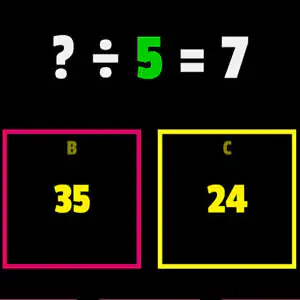
Multiples of 5: division practice with the 5 times table
About Multiples of 5
The multiples of 5 are the easiest to recognise of all the times tables, and this game makes the most of that so children gain confidence with division. Each round shows an incomplete operation, such as ? ÷ 5 = 7, and you have to pick the right answer from several boxes. The key is remembering that 5 × 7 = 35: the missing number is always a multiple of 5. If you want to reinforce this table with other mechanics, there are more 5 times table games.
The complete series up to 50 is 0, 5, 10, 15, 20, 25, 30, 35, 40, 45 and 50. Their big advantage is that they all end in 0 or 5, so many wrong options can be ruled out without doing any calculation.
Video: Multiples of 5: division practice with the 5 times table
How to play Multiples of 5: division practice with the 5 times table: gameplay recorded on Ludorex.
How do you play Multiples of 5?
It's a quick-fire quiz game:
- Look at the result of the division, for example ? ÷ 5 = 9.
- Mentally multiply that result by 5 (5 × 9 = 45).
- Tap the matching option and carry on with the next question.
Multiples of 5 controls
PC
- Mouse click: mark the answer
Mobile and tablet
- Screen tap: choose the correct box
What do you learn in Multiples of 5?
- The 5 times table in reverse, with exact divisions by 5.
- The divisibility rule for 5 based on the last digit.
- The step from counting in fives to multiplying and dividing.
- Everyday uses: the minutes on a clock, 5-cent coins or the fingers on one hand.
Recommended from age 7, as the 5 times table is one of the first learned in 2nd grade, and perfect for practising division in 3rd grade.
Tips for playing better: Multiples of 5
- Look at the last digit of each option: if it doesn't end in 0 or 5, it isn't a multiple of 5. Faced with ? ÷ 5 = 7, an option like 24 is ruled out instantly.
- The times-10-and-halve trick: multiply by 10 and divide by 2. For 5 × 8: 80 ÷ 2 = 40. It works just as well with big numbers (5 × 14 = 140 ÷ 2 = 70).
- Even or odd: if the result of the division is even, the multiple ends in 0 (5 × 6 = 30); if it's odd, it ends in 5 (5 × 7 = 35). That way you know the last digit before calculating.
- Think of the clock: each number on the clock face equals 5 minutes. The 9 is 45 minutes, exactly 5 × 9.
Multiples of 5 FAQ
What are the multiples of 5?
They're the results of multiplying 5 by any natural number: 0, 5, 10, 15, 20, 25, 30… They always end in 0 or 5, alternating between the two.
How can you tell if a number is a multiple of 5?
Just look at its last digit: if it's 0 or 5, the number is a multiple of 5, however big it is. For example, 1,235 and 4,570 are; 3,452 isn't.
How do you divide by 5 quickly?
Double the number and divide by 10. For 35 ÷ 5, do 35 × 2 = 70 and 70 ÷ 10 = 7. It's the perfect trick for this multiples of 5 game.
Additional information: Multiples of 5
Game type: Maths quiz, 5 times table and division
Recommended age: Ages 7 and up
Technology: HTML5
Platform: Web browser (PC, tablet and mobile)
Enjoyed Multiples of 5? Also try Multiples of 8, Multiples of 4 or Multiples of 7. Find more Times Table Games and hundreds of free online games on LudoRex.
🏷 Math Games, Times Table Games, Educational Games for Kids Aged 7 to 8, Educational Games for Kids Aged 8 to 9
Last update:
Games like Multiples of 5
View all › Multiples of 4: 4 Times Table Game in Reverse
 Multiples of 7: Times Table of 7 Game
 Multiples of 9: A Quiz to Review the 9 Times Table
 Multiples of 3: Times Table of 3 Quiz
 Multiples of 6: Division Table Game
 Multiples of 8: review the 8 times table by dividing
 Multiplication coloring: secret mosaics
 6 Times Table: True or False Game
 Happy Burger: multiplication tables while cooking
 Times Table of Nine: Catch the Cloud with the Plane
 7 Times Table Wheel: practice by multiplying
 Interactive Pythagorean Table: Times Tables
 2 Times Table: Lucky Wheel
 Two-Digit Multiplication Word Search
 Multiplication Tables Tic-Tac-Toe
 Multiplication Highway: Times Table Race
 Christmas Multiplications: Multiplication Tables
 Oxytone, Paroxytone, and Proparoxytone Words: Sort Them