

 Español
 한국어
 Русский
 हिन्दी
 Português
 Türkçe
 Tiếng Việt
 Italiano
 Français
 日本語

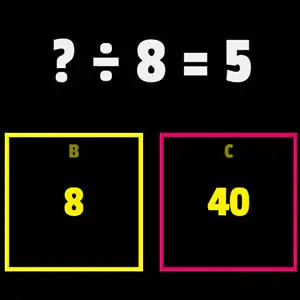
Multiples of 8: review the 8 times table by dividing
About Multiples of 8
In this quiz on multiples of 8 each question is a division with a gap: ? ÷ 8 = 5, ? ÷ 8 = 7… and you have to choose the missing number from several options. To get it right you have to flip the 8 times table: if the result is 5, the hidden number is 8 × 5 = 40. It's a very direct way to check that the table has been learned both ways, multiplying and dividing. To keep practising this particular table, there are more 8 times table games.
The 8 times table is usually one of the hardest, because its results grow quickly and look alike. That's why it helps to see them all together: the first multiples of 8 are 0, 8, 16, 24, 32, 40, 48, 56, 64, 72 and 80.
Video: Multiples of 8: review the 8 times table by dividing
How to play Multiples of 8: review the 8 times table by dividing: gameplay recorded on Ludorex.
How do you play Multiples of 8?
- Read the division shown at the top, for example ? ÷ 8 = 6.
- Think which number divided by 8 gives that result, in other words, work out 8 × 6.
- Tap the box with the correct answer (48) and move on to the next question.
Multiples of 8 controls
PC
- Mouse click: choose the answer
Mobile and tablet
- Tap on the box: select the correct option
What do you learn in Multiples of 8?
- To memorise the 8 times table and to use it in reverse.
- The relationship between multiplication and division as inverse operations.
- To recognise all the multiples of 8 up to 80 at a glance.
- Quick mental arithmetic and strategies like doubling.
Recommended from age 8, when times tables are covered in 3rd grade and division is introduced.
Tips for playing better: Multiples of 8
- Double it three times: multiplying by 8 means doubling, doubling and doubling again. For 8 × 7: 7 → 14 → 28 → 56.
- Look at the last digit: multiples of 8 end following the cycle 8, 6, 4, 2, 0 (8, 16, 24, 32, 40) and then it repeats (48, 56, 64, 72, 80). If an option is odd, rule it out: it can never be a multiple of 8.
- Remember the phrase «5, 6, 7, 8»: 56 = 7 × 8. It's exactly the result people forget most.
- Lean on the 4 times table: each multiple of 8 is double the one for 4 (8 × 6 = 2 × 24 = 48).
Multiples of 8 FAQ
What are the multiples of 8?
They're the numbers you get by multiplying 8 by another natural number: 0, 8, 16, 24, 32, 40, 48, 56, 64, 72, 80, 88, 96… The list is infinite, because you can always add 8 more.
How can you tell if a number is a multiple of 8?
For small numbers, just divide by 8 and see if the division is exact. For large numbers there's a trick: if its last three digits form a multiple of 8, the whole number is one too. For example, 1,024 is, because 024 = 24 = 8 × 3.
What's the difference between multiples of 8 and divisors of 8?
The multiples of 8 are infinite and are found by multiplying (8, 16, 24…), while its divisors are just four: 1, 2, 4 and 8.
Additional information: Multiples of 8
Game type: Maths quiz, 8 times table and division
Recommended age: Ages 8 and up
Technology: HTML5
Platform: Web browser (PC, tablet and mobile)
Enjoyed Multiples of 8? Also try Multiples of 4, Multiples of 7 or Multiples of 9. Find more Times Table Games and hundreds of free games online on LudoRex.
🏷 Math Games, Times Table Games, Educational Games for Kids Aged 8 to 9
Last update:
Games like Multiples of 8
View all › Multiples of 4: 4 Times Table Game in Reverse
 Multiples of 7: Times Table of 7 Game
 Multiples of 9: A Quiz to Review the 9 Times Table
 Multiples of 5: division practice with the 5 times table
 Multiples of 3: Times Table of 3 Quiz
 Multiples of 6: Division Table Game
 Multiplication coloring: secret mosaics
 6 Times Table: True or False Game
 Happy Burger: multiplication tables while cooking
 Times Table of Nine: Catch the Cloud with the Plane
 7 Times Table Wheel: practice by multiplying
 Interactive Pythagorean Table: Times Tables
 2 Times Table: Lucky Wheel
 NEW Pato Multiplicador sin tiempo límite: untimed times tables
 Two-Digit Multiplication Word Search
 Multiplication Tables Tic-Tac-Toe
 Multiplication Highway: Times Table Race
 Christmas Multiplications: Multiplication Tables