

 Español
 한국어
 Русский
 हिन्दी
 Português
 Türkçe
 Tiếng Việt
 Italiano
 Français
 日本語

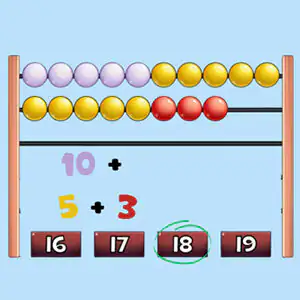
Abacus for Kids: Learn to Count to 20
About Abacus for Kids
This abacus is a virtual activity designed so that children learn to count quantities up to 20 much faster than going bead by bead. On screen you'll see an abacus for kids with rods of ten beads and, below it, four numbers: you have to work out how many beads have been moved and press the correct answer. It's part of our math games for preschool and the early years of primary school.
The abacus is one of the oldest calculation tools in existence and is still used in classrooms because it makes something abstract visible: that ten ones make a ten. Here it's practiced in its simplest form, ideal for making the leap from counting on your fingers to counting in groups.
Video: Abacus for Kids: Learn to Count to 20
How to play Abacus for Kids: Learn to Count to 20: gameplay recorded on Ludorex.
How do you play the abacus game in Abacus for Kids?
- Look at the rods and notice which beads have been moved to one side.
- Count the amount using groups: a full rod is worth 10 and the colors help you see groups of 5.
- Press the correct number among the four options at the bottom.
- If you get it right, you move on to a new amount; if you get it wrong, count again calmly.
Abacus for Kids controls
PC
- Left click: choose the answer number
Mobile and tablet
- Tap: select the answer
What do you learn in Abacus for Kids?
- Counting numbers from 1 to 20 and matching quantities with written numbers.
- The concept of tens: a full rod equals 10 ones.
- Subitizing: recognizing groups of 5 at a glance without counting them one by one.
- Early addition such as 10 + 5 + 3, the foundation of mental math.
Recommended from age 5.
Tips for playing better: Abacus for Kids
- Never count a full rod: if all ten beads are there, just say “ten” straight away and move on to the next one.
- Use the color change: the beads usually come in blocks of five, so a whole block is 5 without needing to count it.
- For amounts like 17 or 18, think “ten, fifteen…” and add only the loose beads: it's faster and you make fewer mistakes.
- For parents and teachers: ask the child to say the sum out loud (for example, “ten plus five plus two”) before pressing; this reinforces the reasoning, not just the right answer.
Abacus for Kids FAQ
What is an abacus for kids used for?
It helps them see and handle numbers. With the abacus they understand that quantities can be grouped into tens and ones, which later makes it easier to add, subtract and understand place value.
At what age can you use the virtual abacus?
This activity, with numbers up to 20, works very well from age 5, in the last year of preschool and in first grade. Older children can use it as a quick mental math warm-up.
What are the advantages of abacuses for kids compared with counting on your fingers?
Fingers run out at 10; abacuses for kids let them go past 10 without getting lost and teach them to count in blocks, a much more effective strategy as numbers get bigger.
Additional information: Abacus for Kids
Game type: Educational, math (counting)
Recommended age: Ages 5 and up
Technology: HTML5
Platform: Web browser (PC, tablet and mobile)
Enjoyed Abacus for Kids? Also try greater than less than game, Multiples of 4 or 3D Geometric Shapes. Find more Math Games and hundreds of games you can play in your browser on LudoRex.
🏷 Math Games, Educational Games for Kids Aged 4 to 5, Educational Games for Kids Aged 5 to 6, Educational Games for Kids
Last update:
Games like Abacus for Kids
View all › Greater or Less: A Game to Compare Quantities
 Multiples of 4: 4 Times Table Game in Reverse
 3D Geometric Shapes: Shape Change Race
 Addition for Kids: Simple Sums with Animals
 Cartesian Plane for Kids: Coordinates Game
 Multiples of 7: Times Table of 7 Game
 Multiples of 9: A Quiz to Review the 9 Times Table
 Multiples of 5: division practice with the 5 times table
 Multiples of 3: Times Table of 3 Quiz
 Multiples of 6: Division Table Game
 Multiples of 8: review the 8 times table by dividing
 Cuisenaire Rods Online: virtual manipulative
 Virtual Geoboard: copy shapes on the 5x5 board
 Multiplication coloring: secret mosaics
 Multiples of 2: a quiz on doubles and division
 Wheel of Fortune online: chance and probability
 Tower of Hanoi online: logic puzzle with disks
 6 Times Table: True or False Game